Uptake pathways for volatile perception: Plants “smell” through two routes
A research team led by the University of Bern has shown that plants absorb scent compounds not only through their stomata but also through their leaf surfaces. Even when the stomata are closed – for example, at night or during dry conditions – about 20 to 30 percent of the scent molecules can enter the leaf. This allows plants to detect warning signals from infested neighboring plants and activate their defenses. The findings provide insight into how nature works and could, in the long term, contribute to more targeted plant protection using fewer pesticides.
Plants can detect scents emitted by other plants when they are infested by insect pests. As soon as plants receive these warning cues, they activate their defense systems to better protect themselves. Although many plant species are capable of this, it is still not fully understood exactly how it works. Can plants smell like humans and animals, or do they use different mechanisms to detect and recognize scents? Until now, researchers assumed that plants primarily absorb these scents through their open stomata on the leaf surface. Plants need these tiny pores on the surface of their leaves to absorb CO₂ from the air and, through photosynthesis, produce energy-rich substances such as sugars, which they need for growth and metabolism.
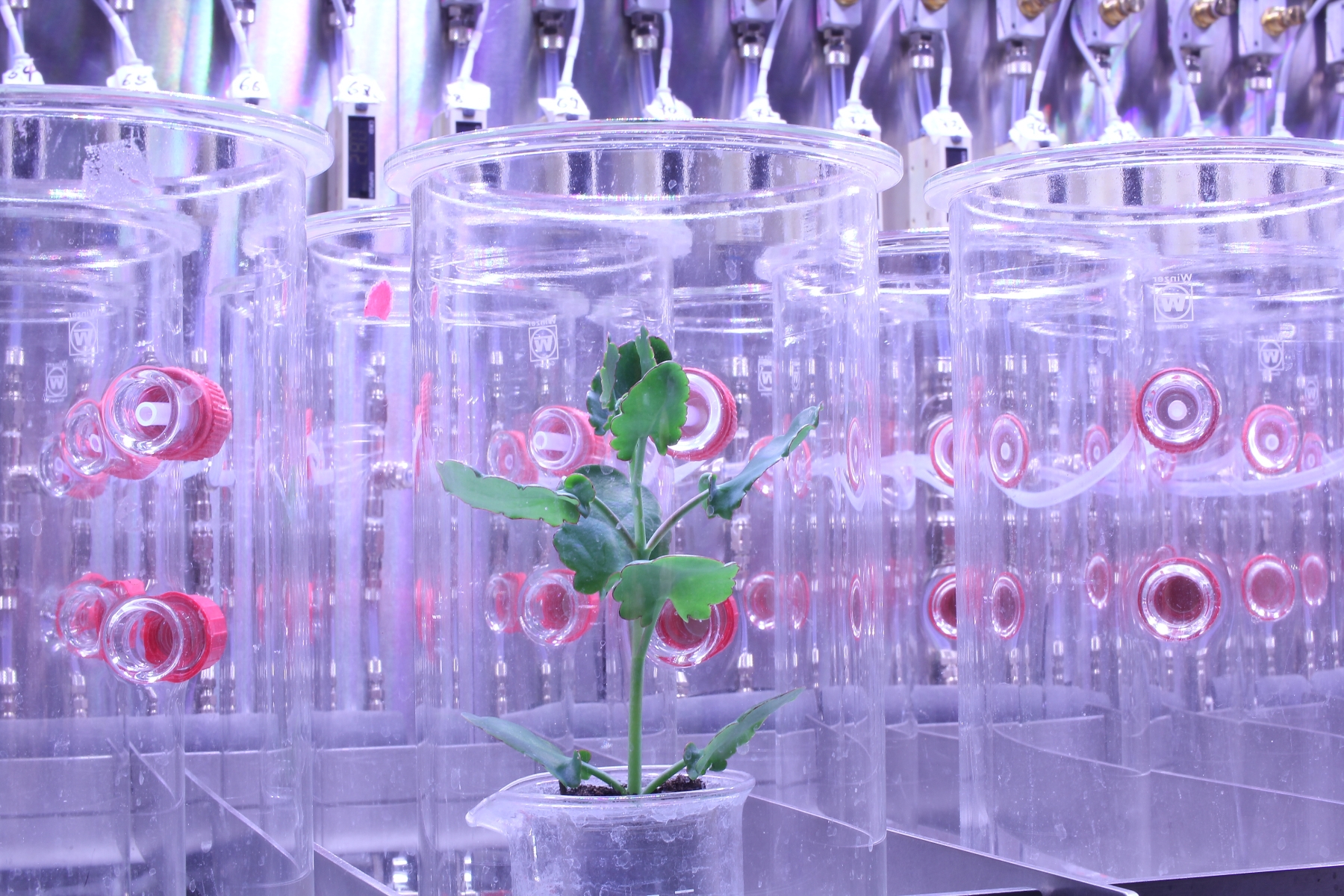
A new international study led by Prof. Dr. Matthias Erb of the Institute of Plant Sciences at the University of Bern uses plants that are particularly water efficient (succulents) of the genus Kalanchoë laxiflora that plants can absorb volatile compounds not only through their stomata but also through the leaf surface. The researchers have thus demonstrated for the first time that this succulent possesses two complementary uptake pathways. Even when the stomata are nearly completely closed, the plant absorbs about 20 to 30 percent of the volatile compounds directly through the leaf surface. The study contributes to a better understanding of how plants perceive volatiles and, in the long term, opens up new approaches for more targeted plant protection using fewer pesticides. The study was published in Current Biology.
A plant with unique characteristics
Until now, the scientific consensus held that uptake through the stomata was the primary pathway by which volatiles enter plant leaves. Although additional uptake via the leaf surface was suspected, it was given little consideration – partly because, until now, it has been difficult to specifically influence stomata without simultaneously altering photosynthesis and thus the plant’s entire metabolism. The research group circumvented this problem by using the succulent Kalanchoë laxiflora for their study, a plant with a unique trait: It produces young leaves that open their stomata during the day and close them at night. At the same time, it has more mature leaves that do the opposite and open their stomata at night. This helps the plant conserve water, since less water evaporates through the stomata at night than during the day. “Thanks to this characteristic, we were able to measure and control in detail how the stomata influence the uptake of volatile compounds and the activation of defense mechanisms,” explains Matthias Erb. In addition, the researchers used hormone treatments and genetically modified Kalanchoë plants with altered leaf structure to test the role of the various uptake pathways more precisely.
Finely tuned uptake of volatile compounds
On the one hand, the study confirms the previous assumption that plants absorb volatile compounds primarily through their stomata. At the same time, however, it shows for the first time that the succulent still absorbs about 20 to 30 percent of the volatile compounds even when its stomata are closed. “Through a series of detailed experiments and modeling, we were able to show that this uptake occurs via the leaf surface,” explains Hao Yu, the study’s first author and a postdoc at the Institute of Plant Sciences at the University of Bern. This absorption occurs primarily through the wax layer (cuticle) and the underlying cell layers of the plant. If the cuticle is artificially thinned or the structure of the outer cell layers of the leaf – located beneath the so-called epidermis, which together with the cuticle forms the plant’s “skin” – is altered, the leaf absorbs significantly more scent compounds.
Furthermore, the study shows that by absorbing scent molecules through the leaf surface, the plant perceives scent signals strongly enough to activate its defenses in a timely manner. “What’s fascinating is that the plant apparently regulates this uptake: When the stomata are closed, uptake via the surface increases, and a specific hormone appears to further enhance this process,” explains Erb.
Potential contribution to plant protection
The ability of plants to perceive scent compounds has long fascinated people – leaves are, in a sense, the plants’ olfactory sense organ. The new study now solves an important part of the mystery of leaf volatile perception. “Our study on Kalanchoë laxiflora shows that plant volatile perception is more robust than previously assumed,” says Erb. “The succulent can detect warning signals from its neighbors even when its stomata are closed via the second, complementary pathway – for example, at night, during drought, or under heat stress – and respond to them in a targeted manner.”
In the long term, this knowledge could also be significant for agriculture. A better understanding of scent perception and the natural defense mechanisms it triggers could help protect crops from pests in a more targeted and environmentally friendly way. “It would be conceivable, for example, to use natural odors to stimulate plants to mount an appropriate defense response at the right time,” says Yu.
Expertise from the University of Bern and state-of-the-art measurement technology
The study builds on the University of Bern’s long-standing expertise in the field of plant-environment interactions and, in particular, plant volatiles. “The University of Bern is a leader in this field of research,” says Matthias Erb. The study was made possible by combining the expertise in stomatal biology at the Institute of Plant Sciences – which has established Kalanchoë laxiflora as a model plant – with a specially developed infrastructure for measuring volatile compounds within the Biotic Interactions group. “This combination of expertise and infrastructure is unique at the University of Bern,” adds Heike Lindner, co-author of the study and assistant professor at the Institute of Plant Sciences, who, together with her research group, investigates the relationships between the unique leaf anatomy and water-saving photosynthesis in succulents. Unraveling how plants perceive odors remains a central goal of the research in Bern. “Building on the current results, we are now investigating which specific molecules act as active signals and whether plants possess their own receptors for these odor compounds,” says Erb.
Publication details:Yu, H., Cofer, T. M., Lindner, H et al. (2026). Uptake via the leaf surface allows plants to perceive volatiles with closed stomata, Current Biology. |
The Institute of Plant SciencesThe Institute of Plant Sciences at the University of Bern is dedicated to understanding the functioning, growth and development of plants. Basic research at the institute covers many fields, ranging from physiology to ecology, and from molecules and cells to entire plants and ecosystems. More information: https://www.ips.unibe.ch/index_eng.html |
28.08.2026